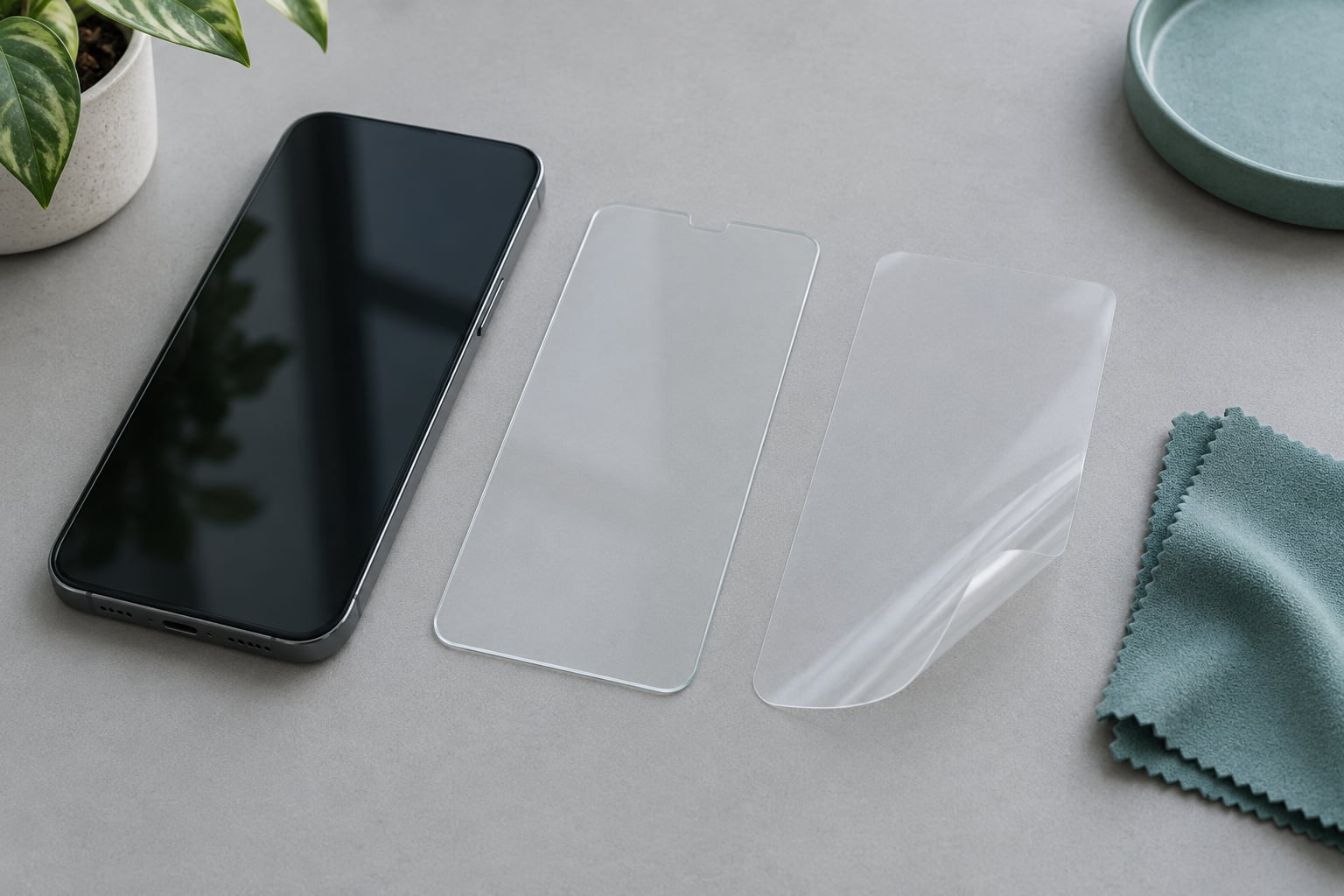
Tempered glass wins on drop protection, scratch resistance and the way the phone feels in your hand. Plastic film wins on curved screens, on thinness, and when you want something you can peel off and replace without fuss. That is the whole argument in two sentences.
Everything below is what that verdict is built on: how each material is made, what happens when your phone hits concrete, and where film quietly outlasts people’s expectations.
Last updated: October 2026.
Table of Contents›
- Tempered Glass vs Plastic Screen Protector at a Glance
- What Is Tempered Glass?
- What Is a Plastic Screen Protector?
- How Do They Compare for Protection?
- tempered glass vs plastic screen protector explained for Clarity and Touch Feel
- Which Material Is Easier to Install?
- Which Should You Choose?
- Frequently Asked Questions
- Is tempered glass better than plastic for a smartphone?
- Does tempered glass prevent a phone screen from cracking?
- Is a plastic screen protector easier to install than tempered glass?
- Will tempered glass work with a curved phone screen?
- How do I choose between a glass and plastic protector for my device?
Tempered Glass vs Plastic Screen Protector at a Glance
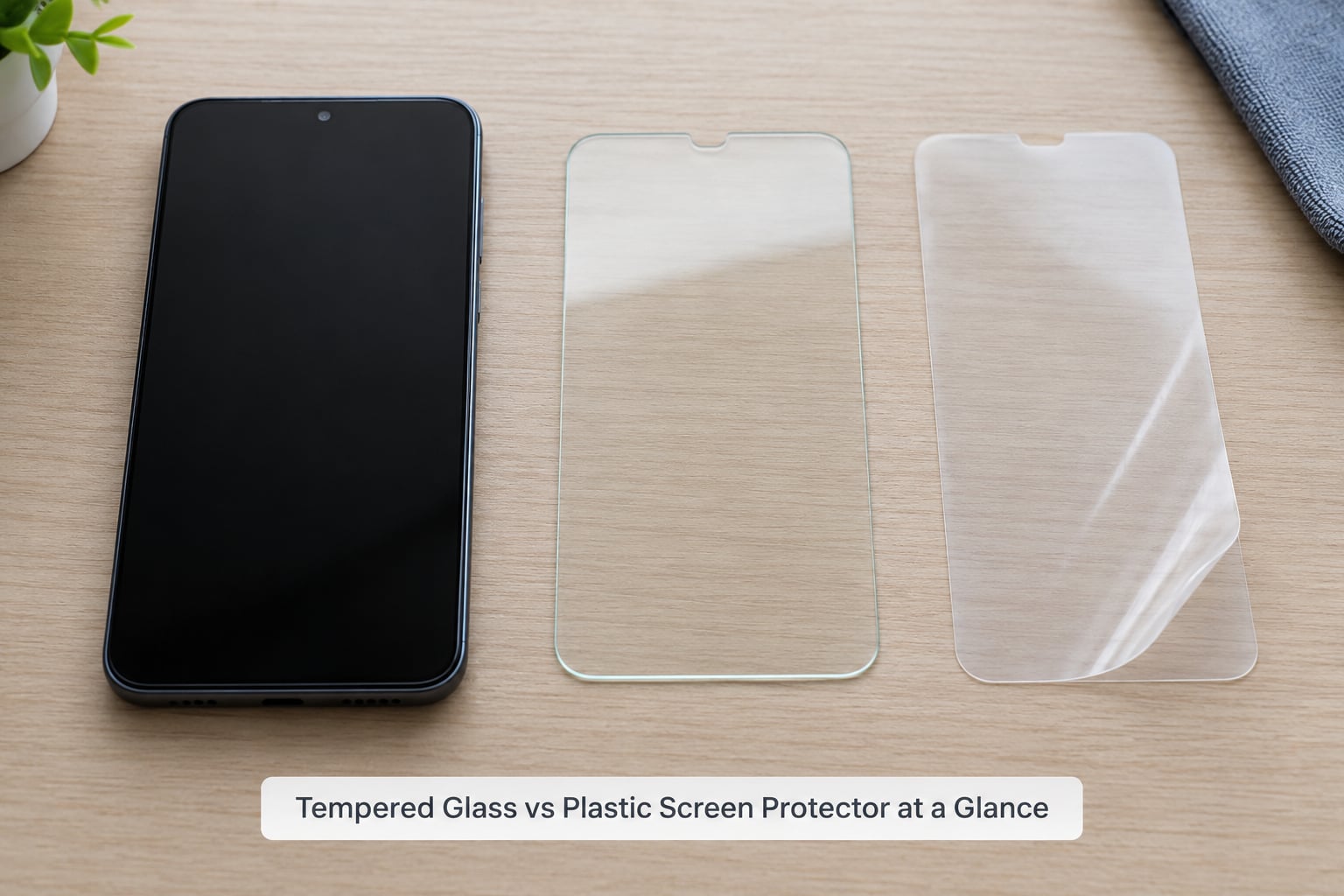
The table below is the condensed version of the whole article. Every row is covered in detail further down.
| Attribute | Tempered glass | Plastic film (PET or TPU) |
|---|---|---|
| Drop and impact protection | Strong. Shatters sacrificially and spreads the impact across the sheet | Weak on hard drops. Flexes, then passes the shock to the display |
| Scratch resistance | High, commonly rated 9H on the pencil-hardness scale | Moderate. Fine micro-scratches build up quickly in daily use |
| Clarity and light transmittance | About 92 percent of light passes through typical glass | Varies. Hard PET is close; cheap film dulls and yellows with age |
| Touch feel | Hard, cool, identical to a bare screen | Soft or slightly rubbery, with a small gap between finger and display |
| Typical thickness | 0.3 mm to 0.4 mm | Around 0.1 mm or less |
| Fingerprint resistance | Good, when it carries an oleophobic coating | Poor to fair; coatings wear off faster than glass coatings do |
| Expected lifespan | 12 to 18 months before the edges lift | 3 to 6 months before peeling or yellowing shows |
| Installation | Rigid and fiddly, but alignment frames make it manageable | Forgiving, and re-positionable during fitting |
| Curved-screen fit | Poor. Flat glass bridges the curve and its edges lift | Good. Flexible film wraps the curve edge to edge |
| Repairability after damage | Replace the whole sheet | Small scratches can sometimes be buffed out |
| Best for | Flat screens, heavy users, phones you drop | Curved screens, thin builds, older or secondary devices |
What Is Tempered Glass?
Tempered glass is a sheet of glass that has been strengthened twice over: first by chemical treatment, where the surface is swapped for a compressed outer layer that resists cracks, and then by heating and fast cooling, which leaves the interior under tension. That tension is what makes it break in a distinctive way.
When something hard hits a tempered sheet, the stresses first spread across the whole surface instead of concentrating at one point. Only when the surface layer finally gives way does the sheet crack. On a phone, that means the protector usually goes first, all by itself, while the display underneath stays intact.
The 9H figure on the box uses a pencil-hardness scale, not the Mohs mineral scale. It means the surface resists marks from a standard 9H pencil, which is a reasonable stand-in for keys, coins and sand. It does not mean the glass resists a hammer, and it does not mean it will not break.
Thickness matters more than most labels suggest. At 0.3 mm to 0.4 mm, glass feels solid under the finger and adds a layer that most people stop noticing after a day. Push it much past 0.5 mm and on-screen buttons start to feel harder to press.
What Is a Plastic Screen Protector?
Plastic is a loose word that covers two very different polymers, and most confusion on this topic comes from treating them as one thing. PET is a stiff, thin film that behaves a bit like glass. TPU is a soft, rubbery thermoplastic polyurethane that stretches and bends.
| Sub-material | Feel | Strengths | Weak spots |
|---|---|---|---|
| PET film | Thin and slightly stiff | Cheap, clear, takes an oleophobic coating | Does not self-heal; scratches stay visible; edges lift |
| TPU film | Soft, rubbery, springy | Wraps curved edges, shrugs off small impacts, self-heals minor dents | Smears fingerprints, collects dust in scratches, can feel hazy after months |
TPU gets a bad reputation it partly deserves. It scratches easily, and because it is soft, every micro-scratch is a visible matte patch that traps dust. It also tends to turn slightly amber after a summer of heat and UV exposure.
The upside is genuine though. A self-healing TPU film will slowly push out a small bubble or dent over a few days, which no glass sheet can do.
How Do They Compare for Protection?
For drops, glass has the better mechanism. A rigid sheet spreads a point impact across its whole area and then cracks on your behalf, so the shock never arrives at the display with full force. Film has almost nothing to spread with, so on a hard landing the energy passes straight through.
That sequence turns up constantly. A phone dropped from roughly 30 cm onto concrete cracks the protector across its corner and leaves the display lit and fully responsive. Switch to flexible film on the same phone and the drop leaves a small dent instead, then the film peels at the edges a few months later and collects grit in the summer heat.
That outcome is the mechanic working, not failing. A cracked protector with an intact screen is the system doing what it was built to do. The confusion is fair, because a shattered protector looks like the expensive thing broke, when in practice it was the cheap layer paying the bill.
For scratches, glass has the clear advantage. The usual verdict from people who have fitted both is blunt: glass is harder to scratch and feels like real glass rather than plastic.
Two caveats matter. First, a protector only protects what it covers, and many phones ship with a film that already sits under the glass layer. Second, the screen material itself, whether that is Gorilla Glass or Ceramic Shield on current flagships, has improved enough that a protector is partly about preserving resale value and avoiding a repair bill rather than preventing instant damage.
tempered glass vs plastic screen protector explained for Clarity and Touch Feel
Good glass passes roughly 92 percent of the light from the display, so the picture underneath looks unchanged. Film sits in the way. Cheap PET dulls contrast slightly, and TPU adds a faint haze once the surface has been wiped a few hundred times.
Touch response follows thickness and rigidity. Glass is hard, so your fingertip stops at the surface of the screen. Thin film is soft, so it absorbs a little of the stroke before the display registers it. On a fast game where you drag and flick, the difference is noticeable; on scrolling, most people never clock it.
Fingerprints come down to the oleophobic coating, the chemical film that makes grease bead up. Glass holds this coating for a year or more before smudging gets heavy. TPU coatings wear off faster, and once the surface is scuffed the smudge layer becomes permanent.
One thing to check before buying either: in-display fingerprint sensors. Some protectors are cut without the right sensor cutout or are too thick for the optical sensor underneath, which causes failed reads. Ultra-thin glass at 0.3 mm or less is the safest pick for those phones.
Which Material Is Easier to Install?
Rigid glass sounds harder, and it is, until you use the frame. Most protectors ship with a plastic alignment tray that holds the sheet exactly where the adhesive needs to land, so you lower it straight down rather than sliding it around. A squeegee card and a clean room finish the job.
Film is more forgiving because it can be lifted and repositioned while the adhesive is still exposed, but it is easier to trap dust and to stretch a corner out of shape. Film that sags into a shallow curve is the classic installation failure, and the wrinkle usually never comes out.
Bubbles are the number one complaint for both. Small ones near the edges are cosmetic. A large bubble across the middle is a dust speck, and it will not clear on its own unless it is in self-healing TPU, where it can shrink over a few days.
Edge lift is the other one. On a flat screen, glass edge lift means the case is pressing the sheet up. On a curved display, flat glass simply bridges the curve, so the edges peel away from the screen within weeks. Film handles that curve, which is the single strongest practical argument for it.
Where glass wins on installation is repair. If a film lifts or yellows you peel it off and fit a new one. A cracked glass sheet has to be removed and replaced whole, and the adhesive usually takes a chunk of the old coating with it.
Which Should You Choose?
Pick tempered glass if your phone has a flat screen and you drop it, use it one-handed, or hand it to kids. It is also the right call if you care about touch feel and smudges, and if you would rather replace one sheet every year or so than four.
Pick plastic film if the display curves at the edges, on Galaxy S and Note style phones. Film is also the sensible answer for a thin phone where any extra 0.4 mm changes how the device sits in a pocket or on a charger, and for older or secondary devices where nobody wants to fuss with a frame.
Pick PET film if your priority is keeping an existing screen looking new, on a phone you rarely drop and use gently. Pick TPU if you need curve coverage, have had a cracked protector before, or expect to knock the phone around.
Pick both if you are indecisive and have a curved screen. A cheap flexible film underneath a glass sheet on the flat centre gives you curve coverage plus drop protection on the part of the display that takes the hits. Owners do this, though two layers will not sit perfectly flush, and touch feel gets slightly mushy.
Frequently Asked Questions
Is tempered glass better than plastic for a smartphone?
For most modern phones with a flat screen, yes. Tempered glass resists scratches far better, spreads a drop impact across the whole sheet, and feels identical to a bare display. Plastic film pulls ahead on curved screens, where flat glass cannot stay glued along the edges, and on thinner builds where every fraction of a millimetre matters. Curved phone, choose film. Flat screen, choose glass.
Does tempered glass prevent a phone screen from cracking?
It cannot guarantee it, but it changes the odds a lot. The sheet spreads the point of impact, then cracks sacrificially so the display never sees the full force. A shattered protector with an intact screen is a good outcome, not a wasted purchase. Real drops still land edge-on or corner-first in ways no protector is built to handle, so a case still matters.
Is a plastic screen protector easier to install than tempered glass?
Usually yes, because film can be lifted and repositioned while the adhesive is exposed, which glass cannot be. The trade-off is that film traps dust and stretches more easily, and a crease that forms during fitting usually stays there. With an alignment frame and a clean surface, glass becomes straightforward too, and it needs no trimming at all.
Will tempered glass work with a curved phone screen?
Poorly. A flat glass sheet bridges the curve, so its edges sit above the display and peel away within a few weeks, leaving visible gaps and extra edge lift. Makers bend glass to follow the curve, but the fit is rarely perfect and it costs more. For a curved display, flexible TPU film or a purpose-bent protector is the more honest option.
How do I choose between a glass and plastic protector for my device?
Check three things in order. Is the screen flat or curved at the edges? Curved means film. Do you drop the phone often? Often means glass. Does the phone use an in-display fingerprint sensor? If so, stay under 0.4 mm or confirm the protector is cut for it. Add your case choice to that check, since a tight case pushes protector edges up.
Start with the shape of your screen. Flat and dropped often means tempered glass, curved edges or a thin build means film, and the rest of the decision follows from those two answers.