A phone case actually protects your phone when its engineering absorbs the impact, not when its brand sounds impressive. Look for reinforced corners, a shock-absorbing inner layer, raised edges above the screen and camera glass, and an exact fit to your model, then verify any drop rating before you buy. The drop height printed on a box tells you very little on its own.
Most people pick a case by appearance, then find out months later that the “military-grade” shell cracked on the first real drop while the phone survived it. That is not bad luck. It is a design choice dressed up as a specification, and it is far more common than manufacturers would like you to know.
This guide gives you a repeatable way to choose a phone case that actually protects, whether you have cracked three phones already or you are simply buying your first real case. No product rankings, no brand worship. Just the checks that separate engineering from packaging.
Table of Contents›
- How to Choose a Phone Case That Actually Protects
- What Protection Level Do You Need?
- Materials and Construction: What Each One Absorbs
- Which Case Style Gives You the Most Protection?
- Why Case Fit and Coverage Matter
- Why Raised Bezels and Screen Protectors Fight Each Other
- How to Check Protection Before You Buy
- What MIL-STD-810G and MIL-STD-810H Actually Test
- The Four Questions to Ask About Any Drop Rating
- Wireless Charging, Magnets and Case Thickness
- What About Grip, Cleaning, and Long-Term Durability?
- How Much Protection Is Worth Paying For?
- Frequently Asked Questions
- Do I need a rugged case if I do not drop my phone often?
- Will a phone case work with a screen protector?
- Does a thicker case always protect a phone better?
- Can I use wireless charging with a phone case?
- Are waterproof phone cases reliable?
- How often should I replace a phone case?
- Conclusion
How to Choose a Phone Case That Actually Protects
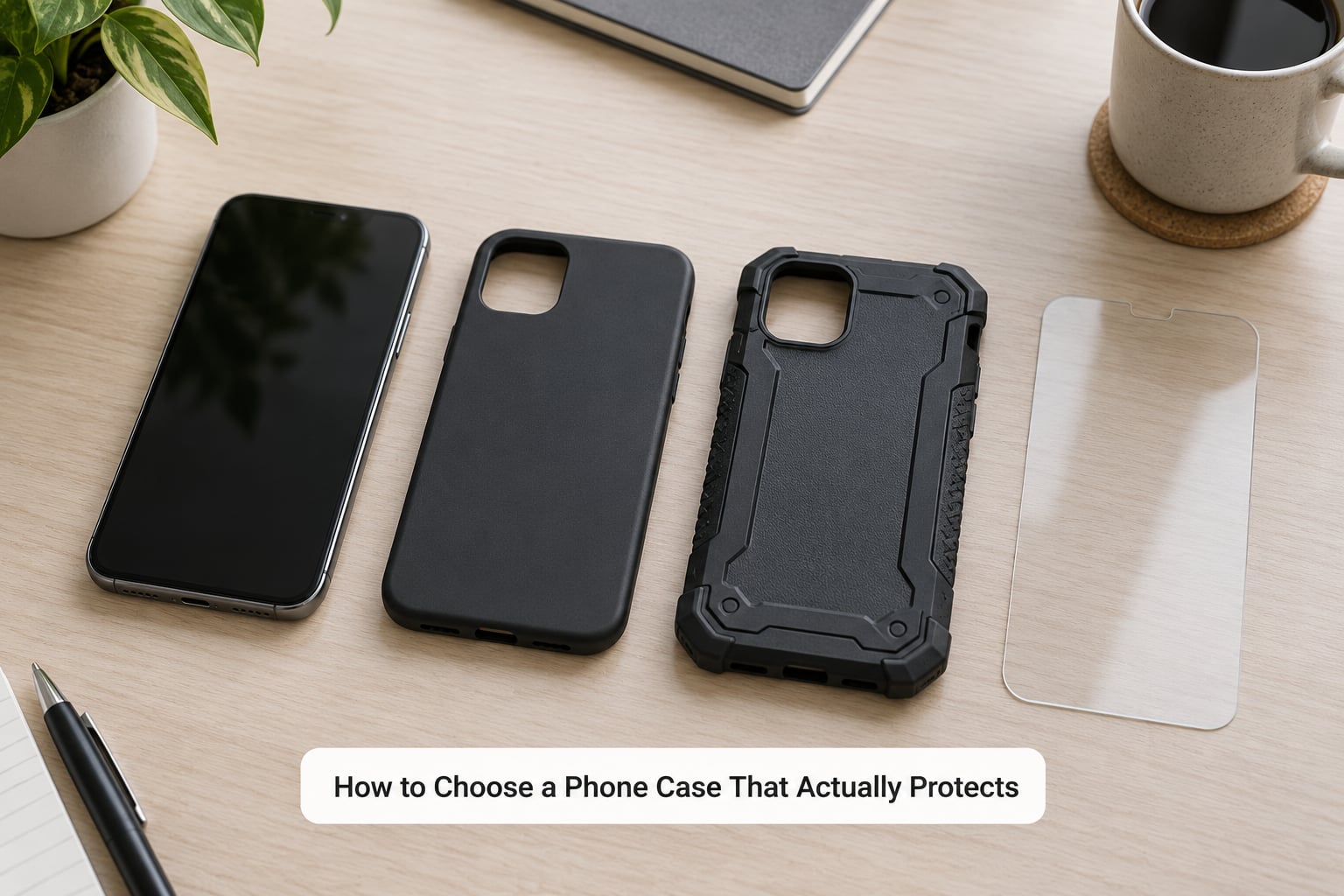
Six things decide whether a case protects your phone. Everything else is decoration, and some of it is decoration you are paying extra for.
- Your real risk. A desk worker, a construction worker and a parent handing a phone to a toddler do not need the same case. Decide how the phone actually gets dropped before you decide how much armor to carry.
- Corner engineering. Phones land on corners more often than they land flat. Reinforced corners or air-cushion pockets are where real protection lives.
- Raised edges. A lip around the screen and around the camera bump decides whether glass touches concrete. A flat-edged case protects nothing on a flat drop.
- An inner shock layer. Rigid outer shell, soft inner layer. That pairing is what slows an impact down.
- Exact model fit. Right model, right variant, right year. A case that fits “the series” but not the model has gaps where the phone can find a hard surface.
- Usability. If the case is uncomfortable enough that you take it off, its protection rating is zero. Comfort and grip are protection features.
Work through those six in order and the marketing language stops mattering, because you will already know what you are looking at.
What Protection Level Do You Need?
Four levels cover almost everyone, and buying above your level mostly adds bulk.
| Level | What it actually covers | Who it suits |
|---|---|---|
| Scratch and scuff | Keys, sand, pocket grit, desk contact | Careful carriers who rarely drop and never work rough |
| Basic drop | Slips from a pocket or a table, roughly waist height | Daily carry, most people, most of the time |
| Rugged impact | Corner-first drops, stairs, gym bags, concrete, hard floors | Frequent droppers, outdoor work, kids, travel |
| Water and dust | Rain, splashes, sand ingress; rarely full submersion | Outdoor use, travel in wet climates, field work |
Be honest about your history rather than your intentions. If you have a screen repair in your past, you are a rugged-case buyer even if this year has been calm.
Materials and Construction: What Each One Absorbs
Material names are marketing-neutral. What matters is whether the design pairs a hard shell with a soft core.
| Material | Behaviour in a drop | Watch out for |
|---|---|---|
| TPU | Flexible, deforms and spreads impact energy | Stretches, yellows, goes slack over time |
| Polycarbonate | Rigid, disperses force across the back panel | Brittle without a soft layer; scratches visibly |
| Silicone or rubber | Very grippy, absorbs shock well | Collects lint and dust; grips pocket fabric |
| Leather or leather-like | Modest absorption, improves grip with wear | Thin shells protect poorly; ages into creases |
| Hybrid (shell plus liner) | Rigid outside, compressible inside, best of both | Adds bulk; cheaper hybrids use thin liners |
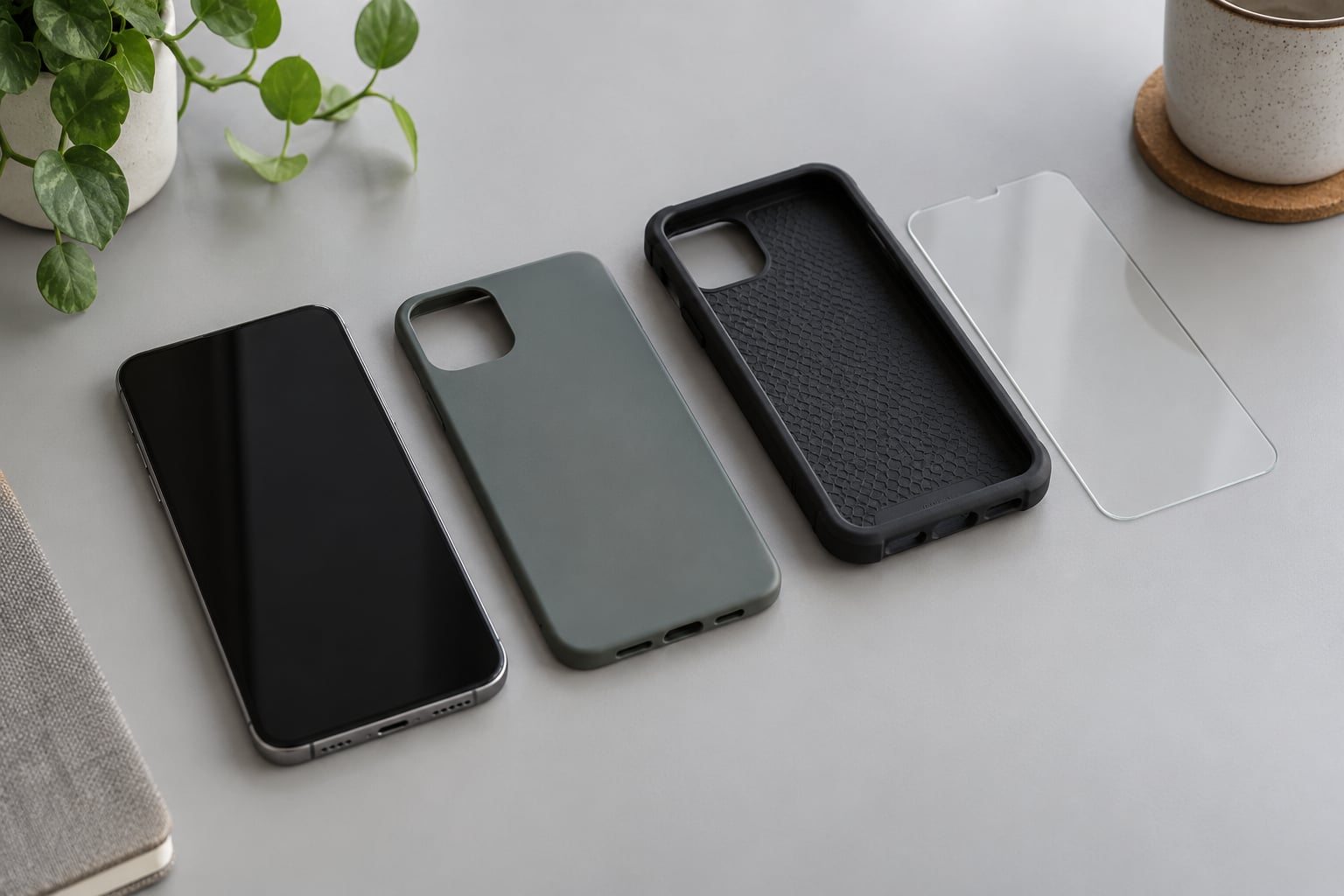
A cheap case is usually a single rigid shell with a decorative pattern on the back. Feel the inside: if it is smooth plastic all the way through, there is nothing there to absorb anything.
Which Case Style Gives You the Most Protection?
Style and protection are not the same axis, which is where most buyers go wrong. These are the six styles you will actually see.
| Style | Real protection level | Best for | Main tradeoff |
|---|---|---|---|
| Rugged | Highest | Drops, outdoor work, kids | Bulky, sometimes warm |
| Wallet folio | High on the screen, moderate on drops | Screen-on landings, card carry | Thick, no pocket one-hand use |
| Kickstand | Moderate to high | Video calls, stand viewing, drops | Stand adds failure points |
| Bumper | Moderate, edges only | Showing off the phone’s finish | Back glass fully exposed |
| Slim | Low to moderate | Pocket carry, wireless charging | Little corner absorption |
| Clear | Any level, cut from any style | Keeping the phone’s color visible | Shows yellowing and scuffs fast |
Rugged wins on protection because it spends the extra bulk on corners, raised lips and a back panel that reaches past the camera bump. Slim cases usually do the opposite: they look good, sit flat against a table and pass every drop straight through.
Why Case Fit and Coverage Matter
A protective case that does not fit properly is decorative. Gaps are failure paths, and the phone will find them every time.
Check four things. The case should hold the phone with no rocking or side play, which means the buttons and edges are doing real work. Cutouts should be generous enough that a thick case still lets a charging cable seat fully. Buttons need covers that stay clicky instead of turning mushy after a few months. And the back should reach past the camera bump far enough that the lens glass rests on the case, not the table.
Rugged cases usually get this right because the openings are large by design. Slim and bumper cases get it wrong more often, since shaving down the lip is how they stay thin.
Why Raised Bezels and Screen Protectors Fight Each Other
The most common real-world complaint about protective cases is that the case itself lifts or cracks the screen protector. That happens for a mechanical reason worth understanding before you buy either one.
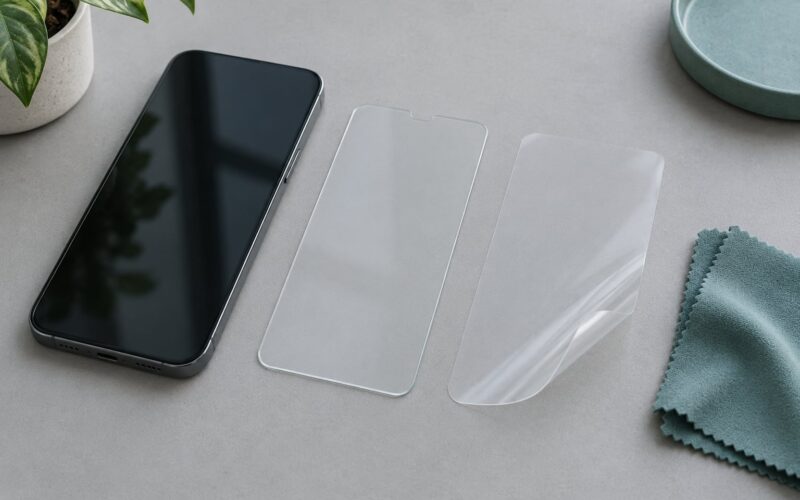
A tempered glass protector adds roughly 0.3 to 0.7 mm of thickness above the screen surface. If the case lip sits lower than the top of the protector, every time the phone lands face-up, the load first hits the raised edge of the glass and levers it away from the screen. The glass is stronger than the phone’s edge, so the glass cracks first.
The fix is simple. Ask the manufacturer whether the case is designed to clear a protector, or check whether the case and protector are sold as a matched set. If the lip is shallow and you plan to use a thick glass protector, either pick a case with a deeper bezel or move to a thinner film-style protector, which flexes instead of chipping.
This is the single most useful question I would ask in a store, and it is one of the few that vendors usually answer honestly.
How to Check Protection Before You Buy
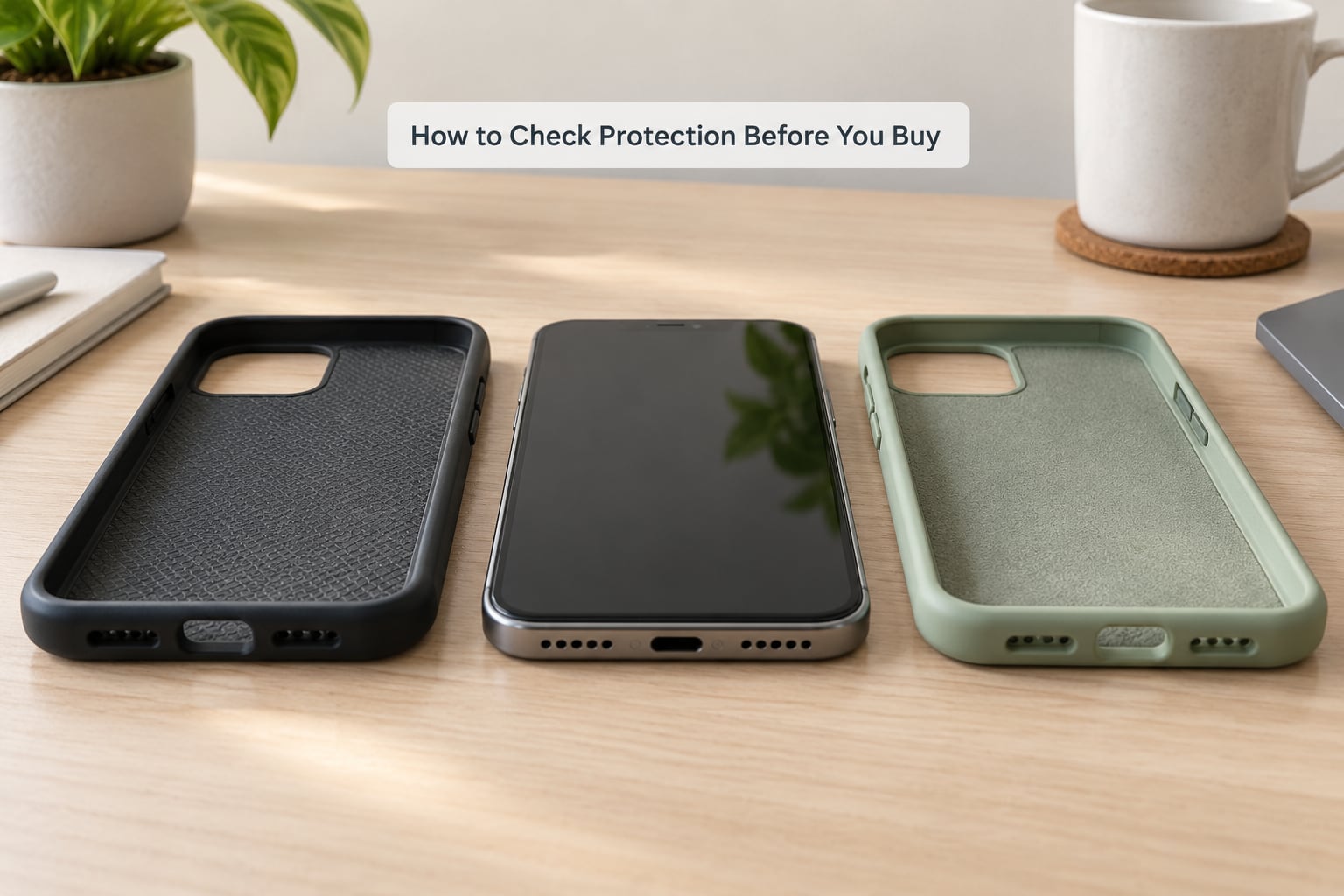
Run this list before checkout. It takes about five minutes and catches most disappointing purchases.
- Raised screen lip. Lay the phone face-up on a table. If the screen touches the table through the case, the lip is too low.
- Raised camera lip. Same test with the phone face-down. The camera bump should sit above the case’s back edge.
- Corner construction. Corners should be visibly thicker than the sides, with molded air pockets or a distinct second layer.
- Inner lining. A soft inner surface, microfiber or otherwise, protects the back glass from scratches inside the case.
- Button feel. Press each button. It should click, not feel spongy.
- Charging test. If you can, plug in the cable you actually use. Some thick cases accept it only at one angle.
- Model and variant. Check the model number in the listing against the phone in your hand. Camera layout and dimensions change within a single series.
- Warranty and returns. A brand that stands behind a case for a year is telling you something about how it was made.
The face-up and face-down table tests catch more bad cases than any spec sheet, because they show you the actual geometry instead of a description of it.
What MIL-STD-810G and MIL-STD-810H Actually Test
MIL-STD-810 is a US military standard for testing equipment in harsh environments, and its drop test is one part of it. In plain terms: the standard drops equipment onto hard surfaces from a stated height, repeatedly, in multiple orientations, and requires that it keeps functioning afterward.
The G and H revisions updated the procedures and some test conditions. H is the current revision. The important detail for buyers is that the standard tests the equipment as a system, not the case by itself, and “functioning afterward” means no catastrophic failure, not “no visible damage.”
It also says nothing about how a case feels, whether it fits your phone model exactly, or how it ages after a year in a pocket. A case carrying that standard still needs its own fit and coverage checks.
The Four Questions to Ask About Any Drop Rating
When a listing claims a drop height, read past the number. Ask these four things and most vague claims fall apart on their own.
- Dropped from what height, and onto what? A meter onto hardwood and a meter onto concrete are different tests entirely. Soft surfaces flatter every case.
- How many drops, and onto which faces? Ten controlled drops onto the corners say far more than a hundred drops onto the back. Phones break at corners.
- How many samples? One surviving sample proves nothing about consistency.
- Who ran the test, and was it third party? Self-reported results are marketing. A named laboratory or an independent reviewer with a published method is evidence.
If a brand cannot answer those four, the rating was chosen for the ad copy rather than the engineering.
Wireless Charging, Magnets and Case Thickness
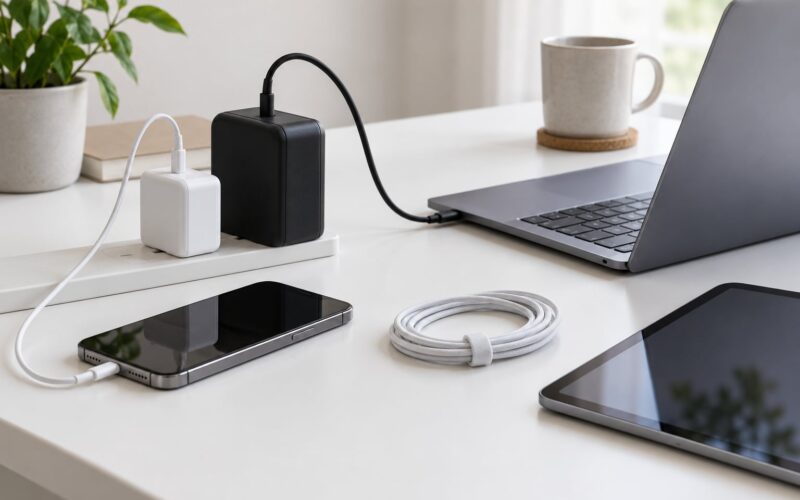
Wireless charging is the most common compromise people accept without realizing it. Coils need space, and a case adds thickness exactly where the pad needs room, so charging slows down or stops aligning if the case is too thick or has metal or magnets in the wrong place.
Magnetic accessories have the same constraint. The ring has to sit close enough to the phone’s own magnets to hold a wallet or a car mount, and bulky cases push it out of alignment so accessories drift and fall off.
If you rely on either, check the case’s stated thickness and whether it is listed as compatible with charging or magnetic accessories. Heavy-duty cases often need an unusually long charging cable to compensate for the deeper port. Buyers on Android forums raise the same two complaints about thick certified cases: heat while charging and weaker signal with some bulky designs, both worth considering if you carry the phone all day.
What About Grip, Cleaning, and Long-Term Durability?
Grip is the protection feature nobody puts on the box, and it may be the one that saves your phone most often. Textured sides and slightly tacky materials let you hold a phone one-handed, which reduces the number of drops instead of surviving them.
Glossy hard cases are the ones that slide out of pockets and off tables. Smooth, glossy backs also skid on a table, which is where most desk drops start.
Cleaning is straightforward. Wipe a silicone or hybrid case with a damp cloth and mild soap. Skip alcohol wipes on coated or leather-like finishes, and never use anything abrasive on a clear case, because the coating scratches permanently and never recovers.
Replace a case when TPU starts to stretch and go slack, when corners split or the inner layer shows through a crack, when buttons stop clicking cleanly, or when the raised lip has flattened from being ground down. Clear cases go first on appearance since they show yellowing and scuffs before the protection is gone. A TPU case usually degrades within a couple of years in a pocket, and a hybrid with a decent shell often outlasts several phone generations.
Owners who keep cases across multiple phone models tend to talk about the same two things: whether the case survived real drops, and whether they could stand to leave the case on. Both are worth asking about before you buy.
How Much Protection Is Worth Paying For?
Cost tracks construction, not branding. What genuinely adds money is a second material layer, thick molded corners, a back that fully wraps the camera platform, a deep bezel, and a brand that publishes its test method. What does not add money is a printed drop rating, a textured pattern, or the word “armored” on the front.
The comparison that matters is arithmetic rather than brand. A cracked screen replacement runs several times the cost of a well-built case, and a phone with a damaged screen or camera glass loses resale and trade-in value immediately. That is why a mid-range hybrid case with real corner engineering is the rational purchase for almost everyone, while the budget tier is fine if you are careful and the premium tier only pays off if you drop phones.
Unverified claims are where overpaying happens. Ask for the four drop-test answers, and if a seller cannot give them, the price is buying a promise rather than a product.
Frequently Asked Questions
Do I need a rugged case if I do not drop my phone often?
Usually not. If your phone spends its life on a desk and rarely leaves a pocket, a slim hybrid case with a raised bezel and a camera lip handles everyday slips and pocket grit. Upgrade to a rugged case if you work outdoors, travel, have children, or have already cracked a screen. Protection you leave on the desk in a drawer protects nothing.
Will a phone case work with a screen protector?
Most do, but check the bezel height against your protector thickness. Tempered glass adds thickness that a shallow lip can lever up on impact, so the protector cracks or lifts first. Look for a case sold as protector-compatible, or a matched case and protector set. A thin film-style protector flexes on impact and is the safer pairing with a low-lip case.
Does a thicker case always protect a phone better?
No. Thickness only helps when it is spent on corners, raised edges, and a second material layer. A thick case with a shallow bezel and smooth back can protect worse than a slimmer hybrid with molded air-cushion corners. Judge the construction, not the measurement, and confirm the extra bulk does not block wireless charging or magnetic accessories.
Can I use wireless charging with a phone case?
Usually, but thick cases and cases with metal or badly placed magnets can slow charging or break the alignment. Check whether the case is listed as wireless-charging compatible, and keep the magnetic ring aligned with the phone’s own magnets if you use a wallet or mount. If charging is weak, the case is usually the cause before the charger or the pad.
Are waterproof phone cases reliable?
Treat them as water-resistant rather than waterproof. A sealed case can handle rain, splashes and dust, but a submerged phone left inside a case is a common mistake, and saltwater damages seals faster than fresh water. Confirm a stated ingress rating, keep the ports closed when not in use, and dry the case fully before charging.
How often should I replace a phone case?
Replace it when the material has gone slack, corners have split, buttons feel mushy, or the raised lip has worn flat. TPU cases often lose shape in a couple of years, clear cases yellow and scuff long before that, and hybrids with a solid shell last across several phone models. Replace sooner if you use a magnetic mount daily or the case has taken repeated real drops.
Conclusion
Start by picking the protection level that matches how your phone actually gets dropped, not the one that matches your worst-case fear. Then confirm the exact model and variant fit, check the corner construction and raised lips with the face-up and face-down table tests, and make sure the lip clears your screen protector.
If a listing shows a drop rating, ask the four questions before you pay for it. 2026 is a good year to buy one case that is built properly instead of three thin ones you will lose.