To compare phone specs, ignore the spec sheet’s running order and rank categories by how much they affect your day: battery endurance, chipset performance, years of software updates, display, then camera. Pull matching numbers for each category from one neutral source, translate them into real consequences, and let your own priorities decide the winner.
Spec sheets are written by marketing departments, and every phone looks extraordinary when you read one alone. Two devices with wildly different daily experiences can print near-identical spec lists.
The fix is a repeatable process, and any phone can run through it. This guide covers that workflow, then ranks the specs worth arguing about and the ones that mostly advertise.
Table of Contents›
- What You Need Before You Start
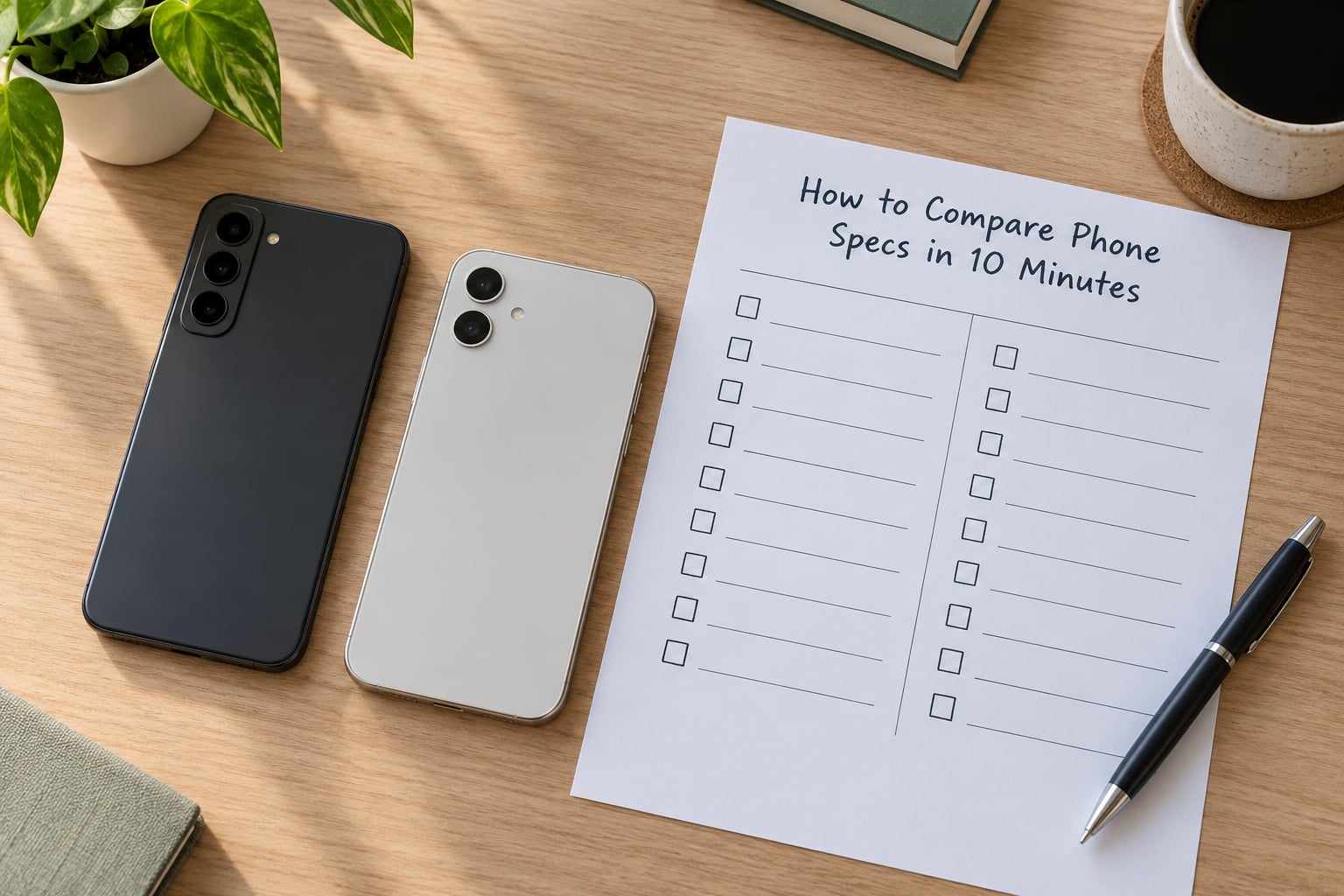
- How to Compare Phone Specs in 10 Minutes
- 1. Write your three non-negotiables
- 2. How to compare phone specs from one neutral source
- 3. Normalise benchmark versions before you compare scores
- 4. Translate each number into a consequence
- 5. Break the tie with hands-on time
- Phone Specs That Actually Matter, Ranked by Impact
- Software support is the longest-lasting spec
- Battery capacity means nothing on its own
- The chipset matters less than its cooling
- Display quality is the first thing specs fail to communicate
- Camera specs: sensor size over megapixels
- RAM and storage
- Specs That Are Overhyped and Safe to Ignore
- How to Read Benchmark Scores Without Fooling Yourself
- Specs That Degrade With Age on a Used Phone
- The 5-Minute Hands-On Test Specs Cannot Replace
- Frequently Asked Questions
- What are good phone specs?
- How do you compare two phones quickly?
- Does an AnTuTu score really matter?
- Which phone specs can I safely ignore?
- How long should a phone get software updates?
- Where to Start: A Simple Decision Checklist
What You Need Before You Start
Four things, and none of them cost money.
- Two candidate phones. Narrowing to two is the hardest part. If you cannot cut the list, you cannot compare.
- A neutral spec database. GSMArena comes up again and again on r/PickAnAndroidForMe as the most reliable cross-device comparison, because it lists the same fields in the same order for every handset.
- One review with stated test conditions. Look for reviews that say how they measured: screen brightness percentage, battery loop, whether the device was on a charger. A number without conditions is decoration.
- A written priority list. Three lines. Battery first, camera never. This is the part most people skip, and it is the part that ends the argument in ten minutes.
Manufacturer pages are useful for one thing: the update policy statement and what’s in the box. Everything else, get from a neutral source so both phones were measured the same way.
How to Compare Phone Specs in 10 Minutes
1. Write your three non-negotiables
Before opening a single spec page, decide what would actually ruin the experience for you. Heavy messaging and navigation is a battery-first buyer. Shooting video of kids is a storage and stabilisation buyer. Keep the phone four years is an update-support buyer.
Three is enough. More than three and you will relitigate the list every time a new phone launches.
2. How to compare phone specs from one neutral source
Open the same database page for both phones and fill one worksheet, row by row. Never mix sources mid-comparison: a battery figure from the manufacturer and a screen brightness figure from a review are not the same measurement, so they cannot sit in the same column.
If you want to compare, the measurement conditions have to match. Mixing sources is how people end up convinced a dimmer phone is brighter than it is.
3. Normalise benchmark versions before you compare scores
Benchmark apps get rewritten, and a score means nothing without its version number. Two phones tested with different AnTuTu versions cannot be ranked against each other, no matter how large the gap looks. Cross-check the version, and if you cannot confirm it, discard the number rather than guessing.
4. Translate each number into a consequence
For every row, finish this sentence: “if this number is higher, then in daily use…” Battery capacity only means something alongside the chipset’s efficiency and the software’s power management. Larger sensors only mean something when the lens can gather light in the situations you actually shoot.
If you cannot finish the sentence, that row is a marketing number. Move on.
5. Break the tie with hands-on time
Specs narrow the field to one or two. Grip, weight, screen feel under a thumb and how the camera feels in the hand settle it. Borrowing a phone from a colleague for five minutes beats another hour of reading.
That is the whole workflow. Five steps, ten minutes, and a decision you can defend to someone who disagrees with you.
Phone Specs That Actually Matter, Ranked by Impact
Ranking from largest real-world effect down: software update support, battery endurance, chipset performance, display, camera, then RAM and storage. The order below is not a verdict on any phone. It is the order in which differences show up in ordinary use.
| Spec | What to check | Real-world impact | Ignore it if |
|---|---|---|---|
| Software updates | Years of OS upgrades and security patches | Determines how long the phone stays safe and current | You replace the phone every two years anyway |
| Battery endurance | mAh plus chipset efficiency and measured screen-on time | The difference between one charge a day and a midday top-up | You carry a power bank daily |
| Chipset | SoC generation, thermals, sustained performance | App switching, camera processing, gaming smoothness | Your usage is calls, maps and messaging |
| Display | Panel type, peak brightness in nits, refresh rate, PWM dimming | Readability outdoors and eye comfort at night | You use the phone indoors at a desk |
| Camera | Sensor size, OIS, optical zoom range | Low-light shots and steadiness of video | Your photos live on social apps and never print |
| RAM and storage | RAM tier, base storage capacity, storage type | App switching and how long you can avoid cloud juggling | You shoot video constantly or keep everything offline |
Software support is the longest-lasting spec
Update length changes your total cost of ownership more than any other line on the sheet. Community consensus on r/Smartphones is consistent on this point: years of security patches matter more than a faster chip for anyone keeping a phone past three years.
Check the manufacturer’s stated support window before anything else. A cheaper phone with two more years of updates can be the better long-term buy.
Battery capacity means nothing on its own
mAh is a reservoir, not a result. A larger battery in an inefficient chipset routinely loses to a smaller one in an efficient chip with good power management, which is exactly the argument that comes up on r/polls.
Read mAh together with the review’s measured screen-on time. That measured figure is the answer to “how to compare phone battery life”, and it is the only one that survives contact with a normal day.
The chipset matters less than its cooling
Peak benchmark scores describe what the chip does for thirty seconds. What you feel is sustained performance, which is thermal throttling talking. The same SoC behaves differently in a thin body with a small vapour chamber.
Look for reviews that report performance after twenty minutes, not just the AnTuTu screenshot.
Display quality is the first thing specs fail to communicate
Peak brightness in nits tells you how readable the screen is in direct sun, and how the auto-brightness behaves when you walk outside. PWM dimming is the flicker-based brightness control used on many OLED and AMOLED panels; sensitive users on r/ScreenSensitive describe it as the first spec that ruins an otherwise good phone.
Refresh rate past 120Hz adds little you will notice daily. Between 60Hz and 120Hz, the jump is obvious the first day.
Camera specs: sensor size over megapixels
A 200MP sensor usually outputs 12.5MP images by default and bins pixels together, so the headline number is not what you get. Sensor size, aperture and stabilisation are what drive low-light results.
Optical image stabilisation uses moving lens elements to steady the shot. Electronic stabilisation crops and sharpens in software, and it costs you framing. OIS is the one to insist on if you shoot in low light or record video while walking.
RAM and storage
8GB of RAM is fine for everyday apps on most current phones. 12GB buys headroom for heavy app switching or demanding games, and below that you will see older apps reload.
Base storage matters more than the maximum. A phone that starts at 256GB with no microSD slot beats a 128GB model that fills up in a year of video.
Specs That Are Overhyped and Safe to Ignore
Some numbers on the sheet carry almost no information. Here is what you can safely skip.
- Megapixels above 50MP. Beyond roughly 50MP, pixel count stops tracking with image quality because output is binned anyway. Judge the sensor size instead.
- Core count on its own. Eight cores is not a quality signal. A chip’s efficiency cores, process node and cooling decide whether those cores are useful.
- Clock speed in GHz in isolation. A higher GHz on an older architecture is regularly slower than a lower GHz on a newer one.
- 144Hz versus 120Hz. The difference is small and battery cost is real. Unless you game competitively, 120Hz is plenty.
- “5G ready” as a checkbox. Nearly every current phone supports 5G. Check the specific bands your carrier uses instead, especially when buying used or importing.
- Expandable storage as a plus. A microSD slot slows writes, and on many current models the card shares the SIM tray. Treat it as a safety net, not a feature to shop for.
None of these decide a purchase on their own. They are the numbers most often used to make two phones look different when the experience is not.
How to Read Benchmark Scores Without Fooling Yourself
A benchmark score is only useful as a comparison with one other phone measured the same way. Version, ambient temperature and cooling all move the number.
| Benchmark | What it measures | How to read it | Common trap |
|---|---|---|---|
| AnTuTu | Broad CPU and GPU mix | Only against phones on the same AnTuTu version | Version bumps inflate scores, making older phones look weaker |
| GeekBench | CPU single-core and multi-core | Single-core predicts everyday responsiveness | Multi-core gaps shrink under thermal limits |
| 3DMark | GPU-heavy sustained loads | Useful for gaming, weak signal otherwise | Ignores thermal throttling after a few minutes |
So does an AnTuTu score matter? Only as a rough tier, inside one version, and only if your usage is heavy. For messaging, browsing, maps and photos, a three-year-old mid-range chip is barely distinguishable from a new one.
A million points on AnTuTu was a genuine flagship result when it first appeared. In 2026 that number is simply entry-level-to-midrange territory, and treating it as a target will push you toward a phone that is slower than you need.
Specs That Degrade With Age on a Used Phone
If you are buying used, some sheet numbers will not survive a battery of tests, because the underlying component has aged.
- Battery health. Ask for battery health percentage, not just charge cycles. Below 85%, expect noticeably shorter days and plan for a battery replacement as a near-term cost.
- OLED burn-in. OLED panels can develop permanent ghosting of status bar icons with heavy use. Check a white screen in a dark room for uneven tinting.
- IP rating. Water resistance is a factory seal test, not a permanent property. Treat a used phone’s rating as expired.
- Storage speed. Older UFS generations feel slower on app installs and cold starts, and no setting fixes it.
- Update window. The remaining support period is the real spec. A two-year-old flagship may have more support left than a new budget model.
The 5-Minute Hands-On Test Specs Cannot Replace
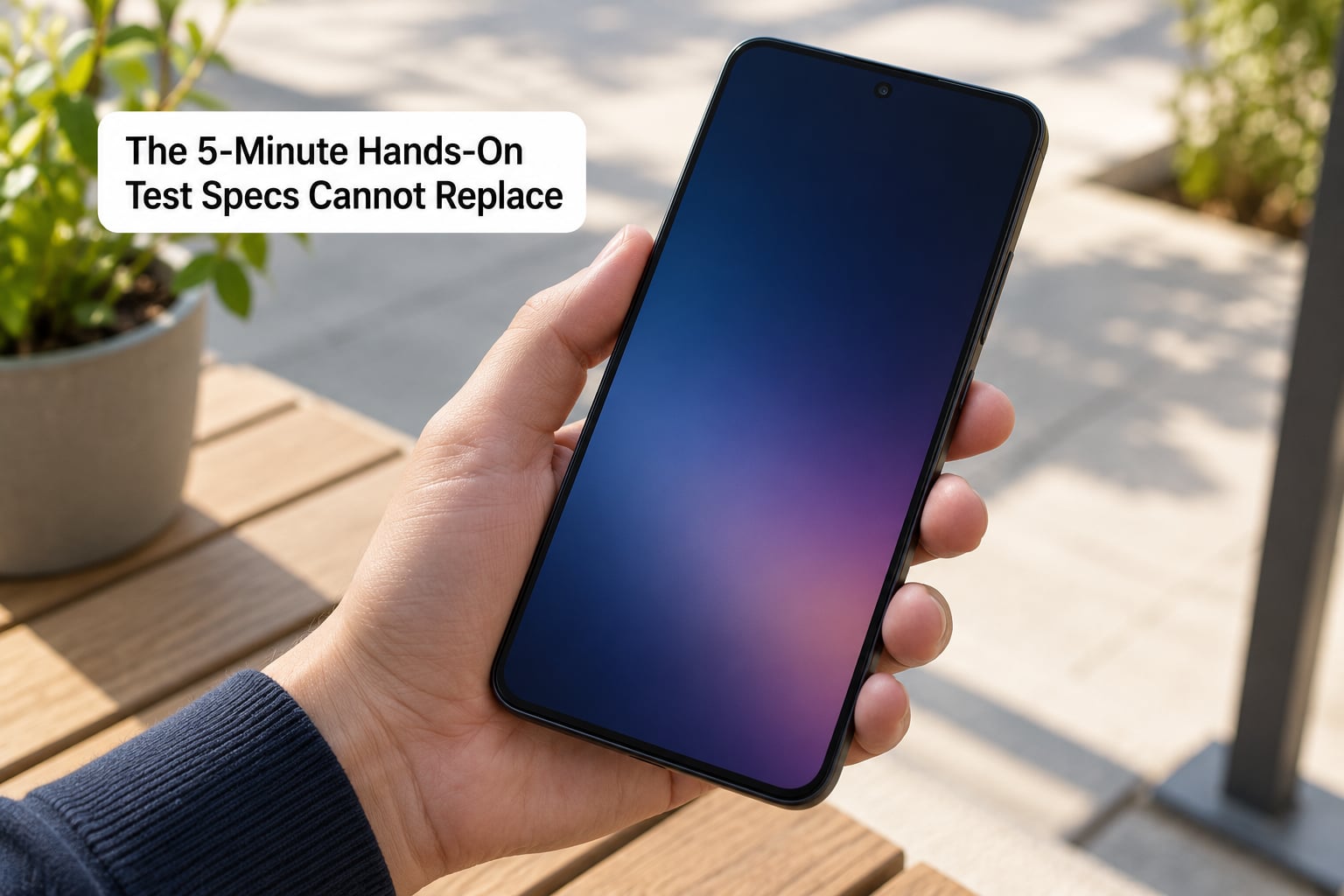
Some things only exist in your hand. Borrow both phones if you can, or do this in a shop.
- Drop brightness to minimum in a dim room. Check for visible flicker and for whether the screen dims further or muddies.
- Scroll a fast webpage. Differences in touch sampling show up as stutter you can feel more than see.
- Open five apps, then switch back. This reveals RAM pressure faster than any spec.
- Hold it one-handed for a minute. Weight and grip decide daily comfort more than any material claim.
- Record ten seconds in low light while walking. Stabilisation tells you more here than the OIS checkbox does.
Five minutes of this resolves most ties that an hour of reading created.
Frequently Asked Questions
What are good phone specs?
Good phone specs are the ones that hold up in daily use: measured screen-on battery life rather than raw mAh, a chipset with sustained rather than peak performance, several years of OS and security updates, a bright screen with 120Hz, and camera stabilisation. Megapixel counts, core counts and clock speeds in isolation tell you very little.
How do you compare two phones quickly?
Pick two candidates, write your three non-negotiables, then pull the same categories for both from one neutral spec database such as GSMArena. Fill one worksheet row by row so every column uses the same measurement method. Translate each number into a real consequence, discard anything you cannot translate, and break any remaining tie with five minutes of hands-on use.
Does an AnTuTu score really matter?
Only within one version of the app, and only as a rough performance tier. AnTuTu is rewritten periodically and newer versions inflate scores, so a number from one year cannot be compared against a number from another. Check the version and test conditions first, and treat cross-version comparisons as meaningless.
Which phone specs can I safely ignore?
Megapixel counts above 50MP, core count on its own, clock speed in GHz by itself, and the jump from 120Hz to 144Hz rarely change how a phone feels day to day. Also be sceptical of maximum storage figures when the base capacity is small, and of 5G as a standalone feature, since bands matter more than the label.
How long should a phone get software updates?
Four years of security patches is a reasonable floor in 2026, and six or more is better if you keep phones a long time. Update length often outweighs a faster chipset in total cost of ownership, because an unsupported phone stops receiving security fixes while a modestly slower one keeps working safely for longer.
Where to Start: A Simple Decision Checklist
Start by writing your three non-negotiables, before you look at a single spec sheet. Then compare update support, measured battery life and sustained performance, using matched numbers from one neutral source. Ignore the rest until you hit a tie, then settle it with five minutes holding the phone.
The order you check things in does more for your satisfaction than the phone you end up with.