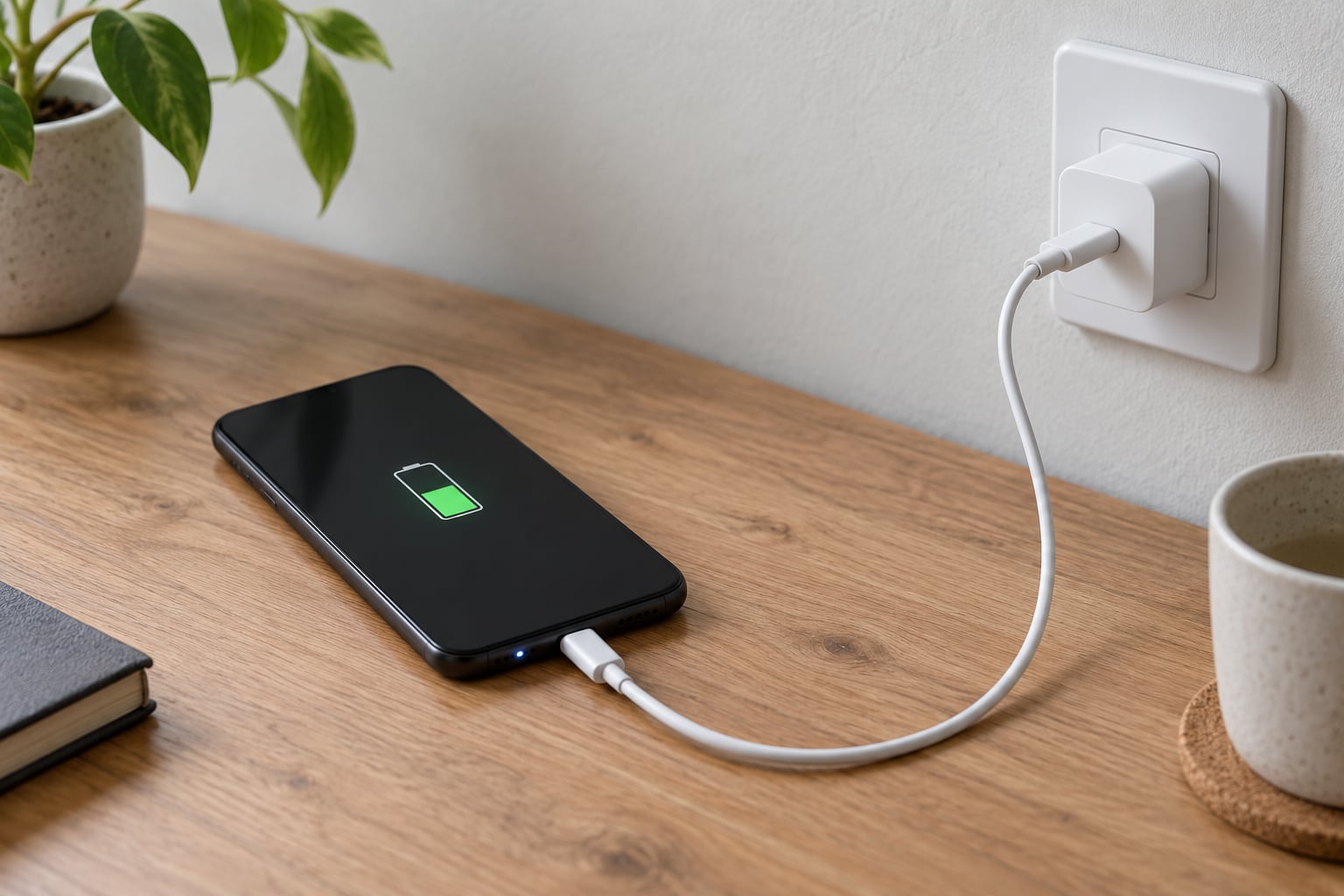
If you have wondered whether is fast charging bad for your battery, the short answer is no, not with a compatible charger. Phones and tablets negotiate a charging rate their battery can handle, and the real long-term stressor is sustained heat, not speed. Over a typical two to three year phone life, the difference between fast and slow charging is measured in a couple of percent of capacity, which is small next to the damage done by heat and by sitting plugged in at a full charge.
That distinction matters because the search results for this question are a mess. Phone fast charging and electric vehicle fast charging get blended together, brand copy and forum opinion get mixed with actual lab measurements, and plenty of people avoid perfectly good chargers out of guilt. I pulled the published test data and the manufacturer documentation together below, then laid out the per-brand settings that actually change charging behaviour.
Table of Contents›
- Is Fast Charging Bad for Your Battery?
- Is fast charging bad for your battery in daily use?
- How does fast charging affect a phone or tablet battery?
- Why does charging speed matter more than the charger’s wattage?
- What does heat do to a lithium-ion battery?
- Does fast charging create more battery cycles?
- Is charging overnight bad for your battery?
- Does wireless fast charging damage the battery?
- How can you fast charge without unnecessary battery wear?
- When is it better to use slow charging instead?
- Frequently Asked Questions
- Should I avoid fast charging if I want my phone battery to last longer?
- Can using a third-party fast charger damage the battery?
- Does fast charging shorten a battery’s lifespan immediately?
- When should I replace a phone or tablet battery?
- What is the safest way to store a phone battery for several months?
- The Bottom Line
Is Fast Charging Bad for Your Battery?
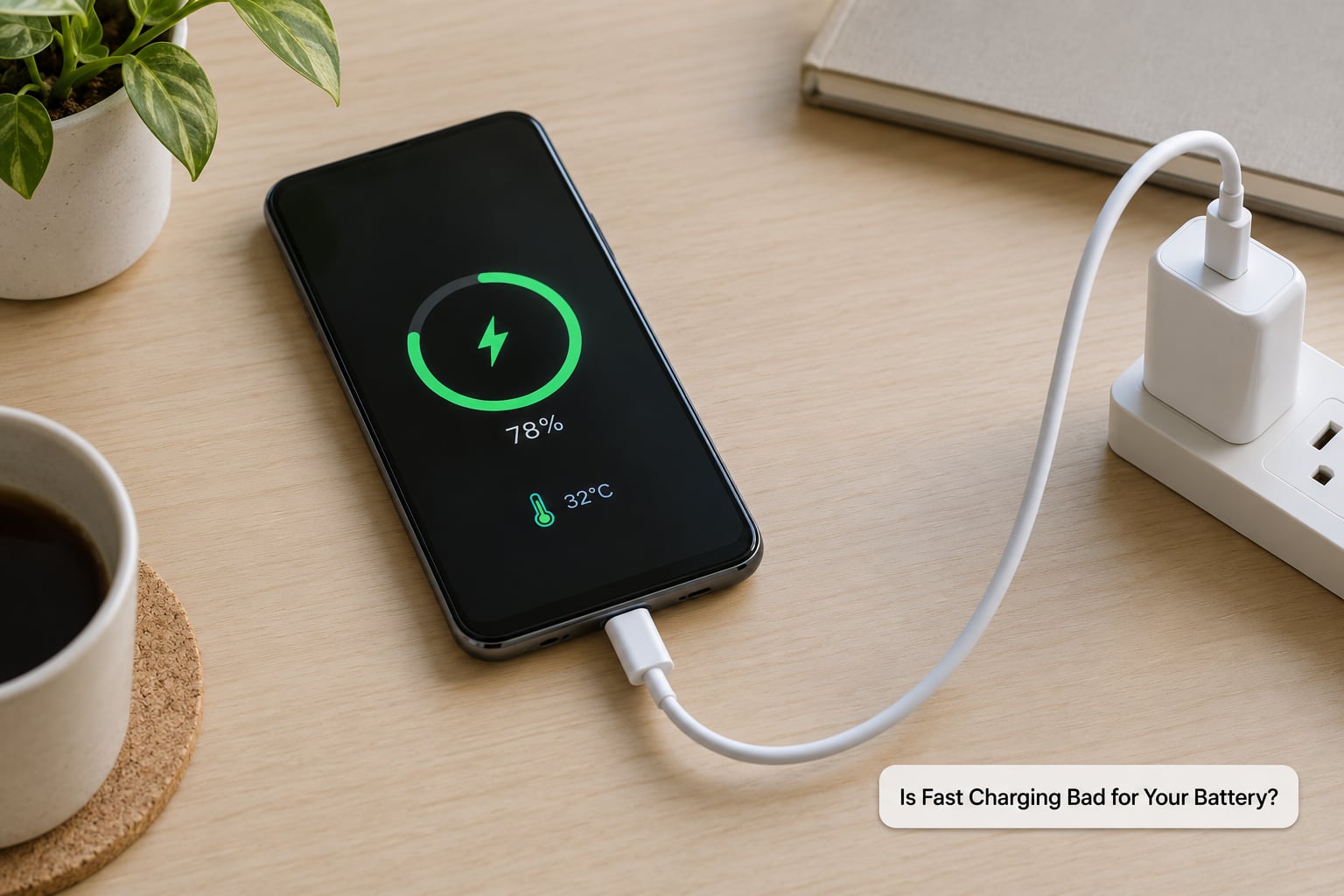
Fast charging is generally safe with a compatible charger because the phone regulates the charging. Sustained heat and long stretches at a high state of charge contribute to gradual wear, so fast charging earns its reputation mainly in situations where it also raises temperature, such as charging while gaming or leaving a phone in a hot car.
To be clear about the mechanism: a faster charge means more current for a shorter stretch, and more current means a little more heat. Phones are built to handle that. They slow down or pause when the battery gets warm, and they reduce current sharply as the charge approaches full. The result is that a fast-charged battery ages at a similar rate to a slow-charged one, which is the opposite of what the most common online warnings suggest.
Is fast charging bad for your battery in daily use?
It depends far more on temperature and time at full than on the charger you used. Somebody who fast charges a cold phone in a cool room is doing almost nothing wrong. Somebody who fast charges a phone under a pillow, in a parked car in July, while running a demanding game, is combining the three worst stressors at once.
| Charging habit | Heat produced | Cycle stress | Convenience | Effect on battery lifespan |
|---|---|---|---|---|
| Fast charging, phone idle, room temperature | Low to moderate | One full cycle | High | Small difference over 100s of cycles |
| Fast charging while gaming or recording video | High | One full cycle | Medium | Noticeable extra wear |
| Slow or low-power charging | Low | One full cycle | Low | Best case for longevity |
| Charging overnight, full at morning | Low after full | Partial cycles | High | Mild, mainly from time at full |
| Charging to 100% and storing for weeks | Ambient | None | None | One of the fastest ways to age a cell |
| Keeping the battery between roughly 30% and 80% | Low | Shallow cycles | Medium | Noticeably longer service life |
Note the last two rows. Charging speed barely moves the needle compared with how long a battery sits at a high voltage, which is why the 80% habit outsells any charger choice in the table above.
How does fast charging affect a phone or tablet battery?
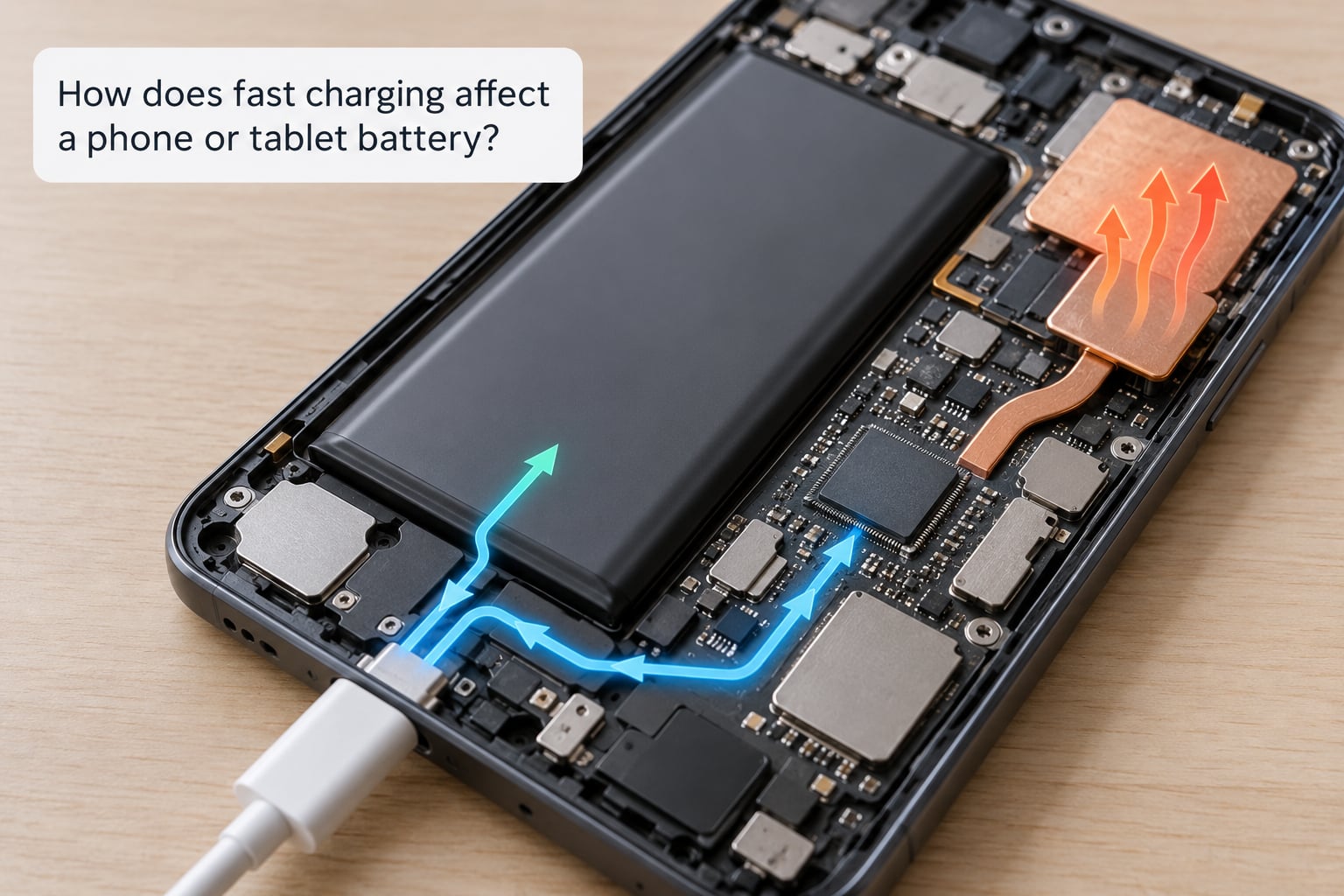
Fast charging is just a higher-power protocol such as USB Power Delivery, Qualcomm Quick Charge or PPS. Nothing about it is exotic, and the battery chemistry is the same lithium-ion pack that shipped in your last three phones.
The charging process runs in two phases, often called the constant-current and constant-voltage curve. During the first phase the phone draws its maximum accepted current, which is where the speed advantage comes from. During the second phase the voltage is held steady and the current falls off a cliff, because pushing more current into a nearly full cell creates stress and heat for very little added charge. That taper is why a phone advertised at 100W typically spends most of its time on the cable well below that number.
Everything happens under a battery management system, the small circuit that watches cell temperature, voltage and current and pulls the plug, or throttles down, when anything drifts outside its safe window. When people describe thermal throttling, that is this system doing its job, not a fault.
So wattage on the charger box tells you very little about battery wear. What matters is the current the phone actually accepts, the temperature of the cell while it accepts it, and how long the cell spends at a high state of charge. A 100W charger in a phone rated for 25W behaves exactly like a 25W charger, because the phone never takes more than it was designed for.
Why does charging speed matter more than the charger’s wattage?
Your charger advertises what it can deliver. Your phone decides what it will take. Everything between those two numbers is negotiation, and the result depends on the protocol both sides speak, the cable in the middle, and the temperature of the phone at that moment.
| Charger rating | Likely negotiated result | What you should expect |
|---|---|---|
| Underrated but protocol compliant, 5W to 10W | Full agreement, low current | Slow, cool, excellent for overnight |
| Matching the phone’s supported protocol, 18W to 45W | Full agreement, high current | Fast for the first portion, tapering near full |
| Rated well above the phone, 65W to 100W, no shared protocol | Falls back to a low basic rate | No faster than a small charger, no extra harm |
| Unrated or uncertified brick | No reliable negotiation | Unpredictable voltage, the actual risk |
| Thin or worn cable | Current limited by resistance | Charging slows, device may warm up |
The fourth row is the one worth worrying about. Forum threads tend to conflate a cheap charger with a powerful one, but the danger has never been wattage. It is a charger that does not regulate output properly, a frayed cable, or a device that will not negotiate a safe voltage. Certified chargers using USB-IF, Qi2 or PPS protocols fail the negotiation rather than forcing a voltage the battery did not expect.
There is one more detail people miss: a fast charger that is also a poor negotiator can still heat things up. If the phone charges quickly and the cell is warm, the thermal system may cut power partway through, so a session that is both hot and incomplete is the pattern to watch for.
What does heat do to a lithium-ion battery?
Heat is the accelerant. Lithium-ion cells age through side reactions inside the electrolyte, and those reactions speed up sharply as temperature rises. A warm room shortens a battery’s usable life; a hot car does far worse. Android Central forum regulars put it bluntly, that it will not hurt the battery as long as you do not overheat it.
Fast charging produces some heat on its own, and that is fine in isolation. The problem is compounding. Charging while gaming, streaming video, recording, or running navigation adds processor heat on top of charging heat, and the two heat sources meet in the same phone. Parking a phone in direct sun or on a warm dashboard while it charges is the worst version of the same idea.
As a practical guide, a phone that feels barely warm during a charge is doing fine. A phone that is uncomfortable to hold for a sustained period, or that has visibly slowed its charge on a cool day, is telling you the thermal system stepped in. Fast charging in a room-temperature room on an idle phone is not the scenario to worry about.
Does fast charging create more battery cycles?
No. Going from empty to full still counts as one equivalent charge cycle, whether it took twenty minutes or eight hours. The cycle count on your device will tick the same amount either way, and cycle count is what the battery management system tracks for its health estimate.
What higher rates do add is stress during the cycle, mostly through heat and through time spent at a high voltage near the end. Over many hundreds of cycles those two effects show up, which is exactly what the well-known bench test by GreatScott! measured. Cells cycled at 1A and cells cycled at 5A over 100 cycles, with the fast-charged group losing an average of 1.6% capacity. The slow-charged group lost less, but the gap was small, and the interesting detail is that the fast-charged cells started to fall away faster toward the end of the test.
A separate slow-versus-fast experiment run by HTX Studio on six iPhone 12 units found a minimal difference after the same period of use. Put the numbers in context: a few percent of capacity across a hundred cycles translates to a difference that stays hidden for most of a phone’s service life, and almost disappears next to the loss from heat or from months parked at a full charge.
Watch your battery health numbers rather than the charge speed. A reading around 80% capacity after two to three years is normal. A sudden drop, a screen that bulges, or a device that will not sit flat on a table is not normal wear, and swelling means stop charging it and get it serviced.
Is charging overnight bad for your battery?
Overnight charging is not bad because the phone runs past full. Modern phones stop drawing meaningful current at 100% and then trickle to offset standby drain. The concern is not overcharging, it is dwell time: sitting at a high voltage for eight hours is harder on a cell than passing through that voltage quickly, which is an argument against fast charging that gets almost exactly backwards.
Apple’s Optimized Battery Charging learns your routine and holds the phone near 80% overnight, finishing shortly before you usually pick it up. Android’s adaptive charging does something similar, and Samsung’s Battery Protection option can hold a limit and drain the battery down a little each week to keep it out of the 100% range. Phones with bypass or direct charging modes, common on gaming phones, power the device from the adapter instead of the battery, which sidesteps the issue almost completely.
Users on r/iphone point out that the power management is handled in software, and users on Apple Discussions note that a lithium-ion cell ages a little faster when it is held at a full charge for days or weeks. Neither the speed nor the fact that it was plugged in all night is the problem. The hours spent at full are.
Does wireless fast charging damage the battery?
Wireless charging is less efficient than a cable, and the energy that does not go into the battery becomes heat. Some of that heat lands in the phone, some in the pad. The phone still runs its normal charging curve and its thermal protections still apply, so this is not a safety story, it is a speed and temperature story.
In practice a wireless pad is usually a slow charger, often 10W to 15W, so the current entering the battery is modest. The larger side effect is that the phone gets warm and stays warm for the whole session, and alignment matters more than people expect. A phone sitting crooked on the pad, or inside a case thicker than a couple of millimetres, charges slower and hotter because more energy is wasted as heat.
Wireless charging earns its place on a desk overnight, where convenience beats speed and the phone is idle. For a top-up before you leave the house, a cable is faster and gentler. If your phone supports it, a magnetic alignment system that snaps the coil into place improves both problems at once.
How can you fast charge without unnecessary battery wear?
Most of the useful work happens in settings, not in the charger drawer. These are the steps that actually change behaviour, with menu paths as of 2026; your version may differ, and manufacturers move things around between updates.
- Use the charger and cable the phone was designed for. A supported protocol negotiates the agreed power. A mismatched brick is not dangerous, but it will not be fast either.
- Turn on the charging protections you already have. On iPhone, Settings > Battery > Battery Health and Charging > Optimized Battery Charging. On Pixel, Settings > Battery > Adaptive Charging. On Samsung, Settings > Battery > Battery Protection, where you can also set a maximum limit.
- Set a charge limit where your phone offers one. A hard cap at 80% is the single highest-impact habit for long-term health, and it costs you almost nothing day to day.
- Take the case off for long or high-power sessions. A thick case traps the heat that the charging system is trying to shed.
- Pause heavy work while charging. Gaming, video recording and navigation while plugged in is the highest-heat combination there is. Charging the phone while you use it is fine; charging it while you hammer it is the one to avoid.
- Keep it out of hot cars and direct sun. Ambient temperature matters more than anything on this list.
- Check the result. Settings > Battery > Battery Health and Charging shows maximum capacity on iPhone. On Android, battery stats and the maintenance or diagnostic screens in Settings > Battery show cycle count and health on many models.
One forum question comes up constantly, whether to switch fast charging off entirely. If you have adaptive charging or a charge limiter enabled, you do not need to. If your device has neither and you are the type to leave it plugged in for two days, a low-power charger in that specific situation is a reasonable habit.
When is it better to use slow charging instead?
Slow charging makes sense in a handful of situations, and only a handful. Charging a phone you will not touch for the next eight hours, where a lower rate means less total heat. Storing a device for weeks or months, which is better handled by partial charge and cool storage than by slow charging on a shelf. Preparing for a trip where you will be off-grid for hours, since the battery you arrive with is the one that has to last.
What is not a good reason is distrust of high-wattage chargers in general. The people I would worry about are the ones charging in a hot environment, at a full battery, for a long time, and there is no adapter rating that changes that. Buying a small extra charger to leave by the bed is a reasonable trick for exactly one habit, avoiding a phone sitting at 100% all night.
Frequently Asked Questions
Should I avoid fast charging if I want my phone battery to last longer?
No. With a compatible charger, fast charging contributes only marginally to wear, and the phone manages current and temperature on its own. If you want the biggest improvement, keep the battery between roughly 30% and 80%, avoid charging while gaming, and stay out of hot cars. Those habits matter far more than the charging speed you use every day.
Can using a third-party fast charger damage the battery?
A certified third-party charger is fine, because your phone negotiates a safe voltage and current and refuses anything higher than it supports. The chargers worth avoiding are uncertified ones with no protocol support, damaged cables, and units with bent or foreign pins. A high-rated charger that does not speak your phone’s protocol simply charges slowly, which is inconvenient rather than harmful.
Does fast charging shorten a battery’s lifespan immediately?
No. Bench tests cycling cells at high and low current over 100 cycles found only a small gap, with the fast-charged group losing about 1.6% capacity on average. A few percent spread over a phone’s whole service life is barely noticeable next to the loss from heat or from long storage at a full charge. It is a slow, gradual effect rather than sudden damage.
When should I replace a phone or tablet battery?
Replace it when capacity drops far enough to affect your day, when runtime is roughly half of what it was new, or when the phone gets hot during ordinary use. Stop using it immediately if the screen bulges, the back lifts, or the device will not lie flat. Check the maximum capacity figure in your battery settings first, since guessing tends to make people replace healthy batteries early.
What is the safest way to store a phone battery for several months?
Store it partially charged, around 50% to 60%, in a cool, dry place away from direct sunlight, and do not leave it in a car or a garage. A lithium-ion cell ages fastest sitting at a full charge, so topping it up before storage is the worst choice. Check it every few months and top it up to the same level if it has drifted well below that.
The Bottom Line
So, is fast charging bad for your battery? Not with a charger your phone was built for. The measured difference between fast and slow charging is about 1.6% of capacity per 100 cycles, and your phone’s own charging curve does most of the protecting. The stressors that actually shorten battery life are heat and long stretches sitting at a full charge.
If you change one thing today, turn on adaptive or optimized charging in your battery settings and, if your phone allows it, set an 80% limit. Keep it out of hot cars, take the case off when you charge for a while, and leave the fast charger in the drawer for the morning top-up. That combination will outlast any amount of slow-charging guilt.